Today I came across the article below while researching lion conservation and was surprised at the title. The statement that this news is considered "shock" research is pretty funny. In a sad sort of way. Actually, what I find shocking is that people aren't aware of the impending extinction of the African lion even though leading conservation groups have been sounding the alarm for years. The threat of extinction has been looming over the lion for the past two decades, yet all of a sudden this revelation is considered "shock research."
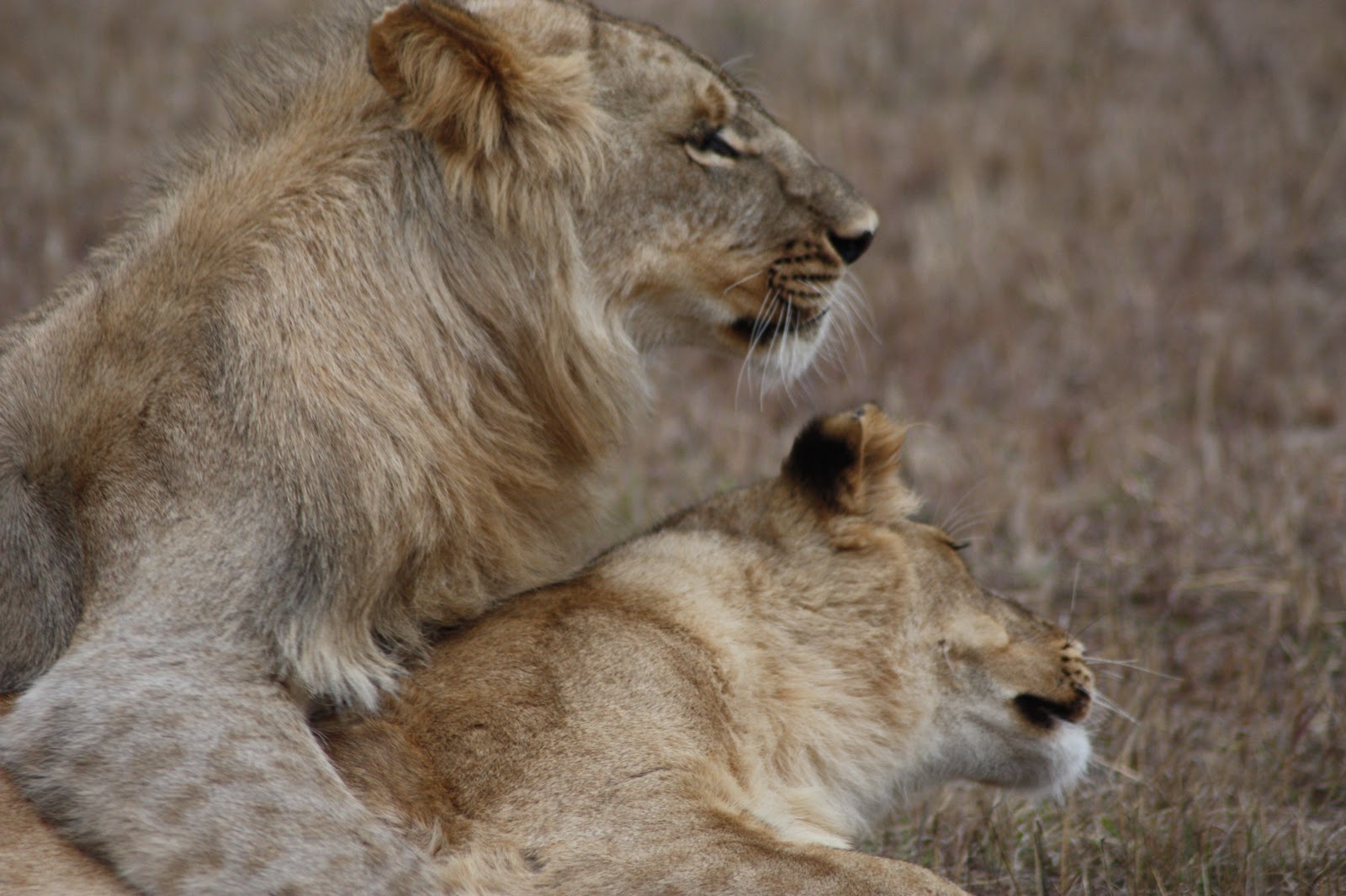
The article is an interview with the wonderful Dereck Joubert, who, along with his wife Beverly, recently made the National Geographic movie about lions titled The Last Lions. I've inserted a few of my lion photos into the article to illustrate what the world will lose when the lions are gone (the article wasn't published with my photos in it). The article is dated February 5, 2011.
Here's a thought on a slightly different subject but still in the lion conservation realm. What if some of the major organizations who use the lion as their logo contributed towards lion conservation? You'd think these companies value the meaning behind their logo and would want to protect the animal that's represented them for so long.
Consider how many organizations - many of them global- such as banks or insurance companies (ING Financial Services), sports teams (the Detroit Lions), volunteer organizations (the Lions Club), studios (MGM Grand), manufacturers (Peugeot), universities, etc. use the lion as their logo. The lion also appears on coats of arms, family crests, and national flags. Why? Because the lion is an easily recognized symbol of strength, power, and courage. Think about it. In as little as ten years this animal that's the universal symbol of strength, power and courage will become extinct. The lion logo will instead become a sad reminder of mankind's failure to protect this iconic species. This strong, powerful and beautiful animal that once served as the very embodiment of those strengths will be gone.
_________________________________________________________________
The Last Lions? from AfricanConservation.org.
Shock research indicates that wild lion populations are more endangered than we thought.
Africa's lions are so iconic, perhaps the most iconic of all the big cats, that bush without them hardly seems like bush at all. Yet, this is what we face in just 10 years, according to shock revelations by South African wildlife documentarians Dereck and Beverly Joubert at their December TED talk in Washington DC.
Their "lion-decline timeline" - as seen on the website for the Big Cats Initiative, their National Geographic-funded conservation drive to save the world's top felines - reveals just how chilling the situation is: in the Jouberts' lifetime alone wild lion numbers have nosedived from 450000 to 20000 (www.bigcatsinitiative.com).
The Last Lions, a considered cinematic contemplation that asks whether ours will be the final generation to witness lions in the savannah, is the Jouberts' latest attempt to keep the king in its jungle. Narrated by Jeremy Irons, it launches in US theatres this month.
Lions gone in 10 years? How do you know this? Who's doing the counting?
Dereck: There was a recent World Conservation Union African Lion Working Group number that came out at about 23000 lions - figures from across Africa from all the group's member researchers. Some researchers are saying 30000, others are saying 16000. One way or the other, where we've come from indicates a curve that is so dramatic that between 10 and 15 years from now it hits rock bottom.
Your claims are like the Inconvenient Truth of lion conservation - this is the first time anyone has stood up and said lions are about to go extinct. How could this have happened to the most celebrated of the big cats?
Dereck: It's difficult to talk about the plight of lions when they are so visual. When you go on safari you see lions clustered in little groups, whereas leopards are spread out far wider and are much harder to see. So it is a bit of a shock to understand that we have between 20000 and 30000 lions left, but this is something that has taken us all by surprise.
There's little wildness left in Africa, and yet wildlife films paint a different picture. To what extent are wildlife filmmakers to blame for public complacency?
Dereck: If every wildlife film came out with an opening shot of a rhino with its horn chopped off, for instance, we'd be living in a very sad world of no beauty, celebration and respect. A balance is the right place to be ... We do this in our own films, such as 'Eye of the Leopard', 99% of which is about celebrating the beauty of that little leopard. But at the end, we point out that 10000 leopards were legally shot on hunting permits while the documentary was being filmed. We have to be careful - an entire series of an Earth that has no reference to the impact of human beings is a tricky one.
What's killing wild lions?
Dereck: We're deeply disturbed about the lion-bone trade. Permits for lion bones have been issued and these bones are now being sold into the East. Lion bones are in such demand because they look so similar to tiger bones, which is a huge trade, but there are only 3200 tigers left in the world and that supply is drying up. The minute there's a healthy trade in animal parts, be it rhino horn or lion bones, these animals become more valuable dead than alive.
Beverly: It's a cultural belief and all about the individual gaining so-called power through a wine made from tiger bones. Logging, slash-and-burn and the bushmeat trade are also killing wild lions, as well as safari hunting, which, genetically, takes out the best specimens, the males - and when one male is shot, between 12 and 20 lions are killed, because a new male comes in to take over the territory and kills all the cubs the dead male has sired. Often some of the females fight to the death to protect their cubs.
Dereck: If you imagine that there are 20000 to 30000 lions left, that implies there are only between 3500 and 5000 male lions and yet the US imports about 550 trophies a year. Another scourge we must be careful of is FIV (feline immunodeficiency virus), which has infected 90% of Africa's lions. A good portion of the lions you and I may have seen in the Kruger National Park are affected with bovine TB, so we have a very vulnerable lion population here.
Photo: Keon Robertson
And yet, the recent opinion piece you wrote for CNN's website provoked several comments that extinction is a 4.5-billion-year-old natural phenomenon; that 99% of animals that have ever lived were killed by several primordial mass extinctions that had nothing to do with man. Unpalatable, but inalienable facts.
Dereck: Species extinctions happen over a long period of time, but man is speeding these up to an epidemic rate. I don't have a beef with natural extinction, but we seem to have taken a place that is no longer natural.
At what stage do we reach the point where Africa's wild lion population becomes unviable? How close are we to that tipping point?
Dereck: As these numbers decline at a steady rate of between 5% and 8% a year, at some point these populations become unviable and are isolated into small, genetic islands across Africa, and what we know from island biogeography is that the closer we get to this, the more rapidly it happens. So it won't be a steady ski slope. It will be a sharp curve right at the end, which is why, with the Big Cats Initiative, we are urging people to look at this as an emergency effort.
Photo: Keon Robertson
Would you like to help the African lion? Here's some links to lion conservation groups that would welcome your donations.
Lions Matter.